

close
Choose Your Site
Global
Social Media
Views: 0 Author: Site Editor Publish Time: 2026-08-26 Origin: Site


Facility managers and homeowners face a massive gap in manufacturer claims regarding ceiling longevity. Estimates for a PVC ceiling panel range wildly from 10 years to over 40 years. This discrepancy creates unpredictable lifecycle planning. Relying on best-case-scenario marketing claims without factoring in environmental stressors, structural realities, and material grades leads to premature replacement. Understanding the true functional lifespan requires looking beyond the sales brochure. Material composition plays a massive role, specifically the ratio of virgin vinyl to recycled plastics. Environmental factors like ambient heat, ultraviolet exposure, and installation integrity directly dictate how long the ceiling maintains its structural properties. This guide establishes a realistic framework for evaluating durability. You will learn how to differentiate between cosmetic wear and structural failure, identify primary degradation risks, and implement installation practices that maximize functional life.
Baseline Lifespan: Quality PVC ceiling panels realistically last 15–25 years in standard indoor environments, with heavy-duty commercial variants exceeding 35–40 years under optimal conditions.
Primary Degradation Risks: Thermal expansion, prolonged UV exposure, improper cutting during installation, and incorrect joist spacing are the leading causes of premature failure (sagging, warping, or brittleness).
Design Impact: The structural profile—such as a PVC tongue and groove ceiling panel—significantly dictates joint integrity, impact resistance, and long-term moisture defense.
Installation Dependency: Lifespan is heavily correlated with adherence to manufacturer-specified batten spacing, proper cutting techniques, and the allowance for thermal movement.
Not all ceiling panels share the same structural DNA. Standard residential decorative panels typically measure between 5mm and 8mm in thickness. These profiles utilize a lighter internal webbing structure designed primarily for aesthetics and basic moisture resistance in bathrooms or kitchens. Because they contain less raw material, their expected functional lifespan hovers around 15 to 20 years before minor deflection or surface wear becomes noticeable.
Heavy-duty commercial panels present a completely different structural profile. Often measuring 1/2-inch (roughly 12mm) thick or more, these multi-wall panels feature a high-density internal truss system. The thicker face and robust webbing allow them to withstand higher impact forces, aggressive cleaning regimens, and greater temperature fluctuations. In commercial kitchens, agricultural facilities, or industrial washdowns, these heavy-duty variants consistently push past the 30-year mark without structural compromise.
Panel Type | Typical Thickness | Webbing Density | Expected Functional Lifespan | Best Application |
|---|---|---|---|---|
Standard Residential | 5mm - 8mm | Low to Medium | 15 - 20 Years | Bathrooms, Kitchens, Basements |
Heavy-Duty Commercial | 10mm - 12mm+ | High (Multi-wall) | 30 - 40+ Years | Warehouses, Washdowns, Ag Facilities |
Search engine results frequently show conflicting lifespans, leaving buyers confused. The discrepancy stems directly from the raw materials used during extrusion. Panels manufactured from 100% virgin vinyl contain no impurities. Virgin PVC retains its plasticizers longer, meaning the panel stays flexible and resists brittleness for 40 years or more. Conversely, panels extruded from recycled PVC contain mixed plastics and degraded polymers. These recycled panels oxidize and become brittle much faster, often failing within 10 to 15 years.
You must also distinguish between aesthetic lifespan and functional lifespan. Aesthetic lifespan ends when the panel exhibits minor fading, slight yellowing, or superficial warping. These changes do not affect the ceiling's ability to protect the room. Functional lifespan ends when the panel structurally fails through cracking, severe sagging, or joint separation. A panel might lose its pristine finish at year 15 but continue functioning as a waterproof barrier until year 35.
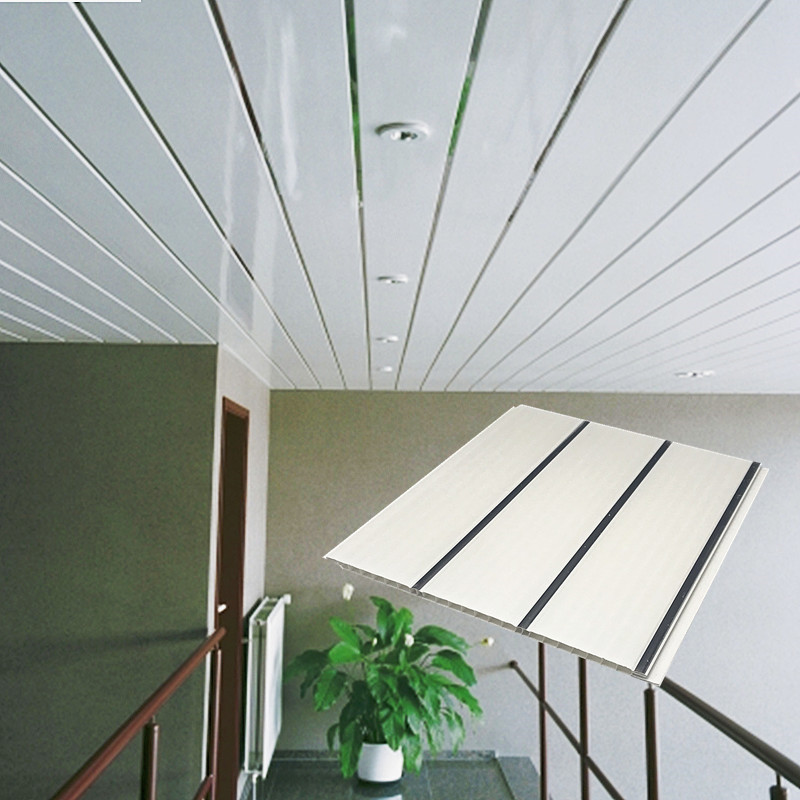
Heat acts as a primary catalyst for PVC degradation. Polyvinyl chloride has a glass transition temperature of approximately 82°C (180°F). Continuous ambient heat exposure above 60°C (140°F) softens the polymer chains. Installing panels in unvented attics, directly above industrial ovens, or in poorly ventilated sunrooms accelerates warping and sagging as the material loses its rigidity.
Ultraviolet exposure triggers photo-degradation. When direct sunlight hits standard indoor PVC panels, UV radiation breaks down the chemical plasticizers that give the material its flexibility. This chemical reaction manifests as yellowing on white panels and leads to severe brittleness. Once the plasticizers off-gas, a minor impact that would normally bounce off the panel will instead shatter it.
Moisture poses zero threat to PVC. Unlike drywall that crumbles or wood that rots, PVC is 100% impervious to water. In high-humidity environments like commercial laundries or indoor pools, the material will never harbor mold or suffer structural degradation from water vapor.
The longevity of the ceiling's visual appeal depends heavily on its surface treatment. Solid-color extruded panels integrate the pigment directly into the raw PVC mixture. A scratch on a solid white panel reveals white material underneath, making wear nearly invisible. These panels maintain their aesthetic baseline for decades.
A printed PVC ceiling panel utilizes a different manufacturing process. Manufacturers apply wood grain or marble patterns using hot-stamping foils or laminated films. While visually striking, these surface layers introduce a risk of delamination. Over a 10-to-15-year horizon, aggressive cleaning chemicals, high humidity, or minor abrasions can cause the printed film to peel or fade, shortening the aesthetic lifespan compared to solid extruded alternatives.
The cross-sectional anatomy of a panel dictates its physical endurance. Looking at the end of a panel reveals a series of vertical or diagonal lines connecting the front face to the back face. These internal trusses act like microscopic I-beams. The frequency and thickness of this webbing determine the panel's rigidity.
Dense webbing prevents long-term sagging under the panel's own weight. It also dictates impact resistance. In low-clearance areas where equipment, ladders, or carried items might strike the ceiling, a panel with thick walls and tight webbing absorbs the blunt force. Panels with widely spaced, paper-thin webbing puncture easily, requiring immediate replacement.
The method used to connect individual panels dictates the overall integrity of the ceiling plane. A PVC tongue and groove ceiling panel provides a distinct mechanical advantage over basic flush-mount or overlapping designs. The deep interlocking mechanism creates a secure, continuous surface that hides the mounting fasteners.
Over decades, buildings settle and experience micro-vibrations from HVAC systems, foot traffic, or nearby roadways. A robust tongue and groove system absorbs these micro-movements without separating. The interlocking joint prevents seams from opening up. This blocks moisture from reaching the substructure and maintains a pristine, unbroken visual line across the ceiling.
Surface profiles also influence long-term performance. A PVC ceiling panel with groove—whether a V-groove or a U-groove—offers specific structural benefits. Flat, seamless panels aim for a monolithic look but easily highlight minor deflections or expansion issues.
Grooved designs naturally mask thermal expansion and contraction. The shadow lines created by the grooves draw the eye away from minor surface variations. As the panels expand slightly in summer heat and contract in winter cold, the grooved joints accommodate this movement visually. This allows the ceiling to maintain a flawless appearance much longer than a completely flat panel that might show slight buckling at the seams.
Sagging is rarely a material defect; it is almost always an installation failure. PVC panels require specific support intervals to remain rigid. Exceeding the maximum span recommendations for battens or joists guarantees long-term deflection. If a manufacturer specifies 16-inch centers for the furring strips, spanning them at 24 inches forces the panel to support its own weight over too wide a gap. Over a few years, gravity and ambient heat cause the plastic to creep, resulting in a permanently wavy ceiling.
PVC has a specific coefficient of linear thermal expansion. It moves as temperatures change. A standard 4-meter panel can expand by several millimeters during a hot summer afternoon. If installers hard-fasten the panels tight against the perimeter walls without leaving expansion gaps inside the edge trims, the material has nowhere to go.
This trapped expansion leads to buckling. The panels bow downward, popping out of their interlocking grooves or tearing away from the mounting screws. Proper installation requires leaving a 5mm to 8mm gap at all perimeters to allow the ceiling to float and breathe with temperature shifts.
The cutting phase introduces significant risk to the panel's lifespan. Using incorrect tools, such as aggressive wood blades with large teeth, rips the plastic rather than cutting it. This aggressive tearing causes micro-fractures along the cut edge. While invisible initially, these micro-fractures propagate over time due to building vibration and thermal movement, eventually turning into visible cracks.
Follow these steps for clean cuts:
Measure and mark the cut line using a high-visibility chalk line or straight edge.
Equip a circular saw or miter saw with a fine-tooth blade (minimum 80 teeth) designed for plastics or non-ferrous metals.
Run the saw backward for the first inch to prevent chipping the edge, then proceed with a slow, steady forward feed rate.
For longitudinal cuts, score the face of the panel deeply with a sharp utility knife and snap it cleanly over a hard edge.
Integrating lighting into a PVC ceiling requires strict thermal management. Traditional high-wattage halogen bulbs or incandescent recessed lights generate intense localized heat. If the fixture housing lacks proper insulation or contacts the panel directly, the PVC melts, discolors, and warps around the trim ring.
All recessed lighting installed in these ceilings must be IC-rated (Insulation Contact) and utilize low-heat LED bulbs. Maintaining proper clearance between the heat sink of the light fixture and the internal webbing of the panel ensures the plastic remains stable and safe.
The longevity of the ceiling relies entirely on the substructure. You can mount panels to treated wood battens or galvanized metal furring channels. Metal furring provides superior longevity in damp environments, as it will not warp or rot behind the waterproof PVC barrier.
To guarantee a 20-plus year lifespan without deflection, install the support battens perpendicular to the panel direction. Maintain a strict spacing metric of 12 to 16 inches on center, depending on the panel thickness. In commercial environments subject to high heat, reducing the spacing to 12 inches provides the necessary rigidity to prevent sagging.
The hardware holding the ceiling up must outlast the ceiling itself. Fastening panels with standard drywall screws or uncoated staples in a humid environment guarantees failure. The fasteners rust, snap, and drop the panels long before the PVC degrades.
Use stainless steel or heavily galvanized fasteners. For wood battens, T50 stainless steel staples applied through the extended fastening flange of the groove provide a secure, hidden hold. For metal furring, use fine-thread galvanized wafer-head screws. Avoid construction adhesives as the primary mounting method; adhesives restrict the panel's ability to expand and contract, leading to buckling.
Maintenance dictates the aesthetic lifespan. PVC requires minimal upkeep, but using the wrong chemicals destroys the surface finish. Abrasive powders, bleach, acetone, and harsh industrial solvents strip the UV-protective layer and degrade the plasticizers, turning the panel dull and brittle.
Implement a strict cleaning protocol using only mild dish detergents mixed with warm water. Apply the solution with a soft microfiber mop or cloth. For stubborn grease in commercial kitchens, use a diluted degreaser specifically rated for plastics. Rinsing the ceiling with clean water after washing prevents chemical residue buildup.
Drywall remains the default ceiling material in many regions, but its lifespan in challenging environments is notoriously short. Gypsum board absorbs moisture readily. In bathrooms, kitchens, or basements, humidity penetrates the paint, causing the paper backing to harbor mold and the gypsum core to crumble. Drywall also requires continuous maintenance: taping, mudding, sanding, and repainting every few years.
In contrast, a PVC panel offers a 15 to 25-year lifespan with zero moisture vulnerability. It never requires painting, patching, or mold remediation. The initial installation represents the final step, drastically reducing long-term labor and maintenance efforts.
Wood ceilings provide high aesthetic value but demand massive maintenance overhead. Natural wood expands and contracts violently with humidity changes, leading to cracked finishes and warped boards. Wood also requires regular sanding, staining, and sealing to maintain its look, alongside constant monitoring for termite or wood-boring insect damage.
PVC eliminates these labor-intensive requirements. It delivers a zero-maintenance reality over a 20-year period. It ignores humidity, repels insects, and never requires a fresh coat of sealant, making it vastly superior for facility managers looking to reduce ongoing maintenance hours.
Commercial spaces frequently utilize mineral fiber drop ceiling tiles. While acoustically effective, mineral fiber is highly susceptible to water damage. A single roof leak or plumbing drip leaves permanent brown water stains. When ambient humidity exceeds 70%, mineral fiber tiles absorb the moisture, gain weight, and sag in the middle.
This vulnerability results in a high replacement frequency, often requiring new tiles every 5 to 10 years. PVC panels offer a "one-and-done" installation. They do not stain from water leaks and will never sag from humidity, providing decades of uninterrupted service without the need for constant tile swapping.
A PVC ceiling panel represents a highly durable, low-maintenance investment that realistically yields 20 to 40 years of service when properly specified and installed. The gap between a ceiling that fails in a decade and one that lasts a lifetime comes down to material quality, structural design, and strict adherence to installation protocols. When shortlisting materials, match the panel to the environment. Select thick, solid-color tongue and groove panels manufactured from virgin vinyl for harsh, high-humidity, or commercial spaces. Reserve thinner or printed panels for climate-controlled, low-impact residential areas.
Take the following steps to ensure a successful installation:
Measure your existing ceiling joist spacing to determine if additional perpendicular furring channels are required to meet the 16-inch maximum span rule.
Assess the ambient temperature and UV exposure of the room to decide between solid extruded panels or printed designs.
Request physical material samples from suppliers to manually test the rigidity, webbing density, and interlocking joint strength before committing to a bulk order.
Verify that all planned recessed lighting fixtures are IC-rated and equipped with low-heat LED bulbs to prevent thermal damage.
A: Yes, their impact resistance depends on thickness and internal webbing. Heavy-duty commercial panels with dense internal trusses easily absorb blunt force impacts from ladders or equipment. Thinner residential panels are more fragile and should be kept away from low-clearance, high-traffic strike zones.
A: Panels made from recycled plastics often become brittle within 10 years due to rapid plasticizer migration. High-quality panels extruded from 100% virgin vinyl retain their flexibility and resist brittleness for decades, provided they are not exposed to direct, prolonged UV radiation.
A: Yes. Traditional halogen or incandescent bulbs generate excessive heat that melts or warps the surrounding plastic. You must use low-heat LED fixtures and ensure all recessed lighting housings are IC-rated to prevent thermal damage to the panels.
A: Moisture has zero negative effect on PVC. The material is completely waterproof and non-porous. Unlike drywall or wood, it will never rot, warp from humidity, or harbor mold, making it the ideal long-term solution for wet environments.
A: Printed panels utilize laminated films or hot-stamped foils that can fade or delaminate over 10 to 15 years if exposed to direct sunlight or harsh cleaning chemicals. Solid-color extruded panels maintain their appearance much longer because the pigment is mixed throughout the material.
A: While you can paint PVC using specialized plastic-adhesion paints, doing so defeats the material's primary advantage: zero maintenance. Painting introduces the need for future scraping and repainting, which negates the long-term labor savings of the panel.
A: Warranties vary significantly by manufacturer and material grade. Standard residential panels often carry 5 to 10-year warranties against manufacturing defects. Premium commercial-grade virgin vinyl panels frequently come with 20-year to lifetime warranties, reflecting their superior structural stability.